
The Smith Disconnection
I have explored every avenue to identify the family history of the Smith family, but it has led almost nowhere. The present generation of Christine, Pamela, Angelina and Trevor can trace their ancestry only as far back as their shadowy grandfather, who made an excellent job of hiding his antecedents.
Let’s start with what we know. There was a man called Harry Smith - father of Vic and Cyril. We know that Harry lived in Willesden at 36 Victor Road. He was a master hairdresser. He was in a partnership with Alice Maud Edmonds. See section on Maud in the Edmonds Connection Actually there was nothing formal about this. There are no records that show that Harry and Alice were ever married. Family tradition says that the family lived above the shop where Harry plied his trade at 36 Victor Road Willesden. Was this number 36 in 1919? This was a traumatic time for our English forebears. World War One had just finished and many men had had awful experiences - today we call it PTSD.. Had Harry been a soldier? Was he wounded? Did he have shell shock? Harry and Alice had two children before Harry abandoned them when the boys were very young. That could have been because he physically walked out or died, or became infirm
-
Victor John Smith born 1 May 1918 at Twyford Lodge, Willesden. In 1918 Twyford Lodge was Willesden workhouse.In 1914, the workhouse was renamed Willesden Institution, and then in 1921 became Park Royal Hospital. However, to protect those born in the institution from stigma in later life, their place of birth was recorded as "Twyford Lodge". Victor’s story continues below.
-
Cyril Leslie Smith born 14 October 1919 Municipal Hospital, Dog Lane, Willesden. Dog Lane Hospital is considered one of London’s lost hospitals. I can’t find any pictures of it except for a hospital wall. In 1894 Willesden District Council opened a fever hospital on an isolated 10 acre site in Dog Lane (the Stonebridge portion of Dog Lane was later renamed Brentfield Road), nearby the local sewage works. The Hospital was extended in 1904, when it then had 150 beds. During WW1 its name was changed to Willesden Municipal Hospital. In 1922 it was debated whether it should be further extended and become a general hospital, but it remained an infectious diseases hospital. By 1922 it had 138 beds. Cyril’s story continues
Why did Harry abandon his family? I had hoped that the Catholic Children’s Society had some evidence that would shed light on this subject, sadly they didn't. Their mother, alone, with no way of keeping them fed, reluctantly placed them into the Catholic orphanage of St Mary’s. See page about this orphanage.
As Cyril and Victor were put into a Roman Catholic Orphanage it would seem likely that Harry was a Roman Catholic and they would likely have been baptised into that faith before they entered the orphanage. I employed a researcher and she reported that Alice was baptised into the Church of England and her parents were married in a C. of E. church, but she may have changed her denomination at some time, possibly in the 1920’s. As the boys were living in Willesden when they were young, the researcher contacted Our Lady of Willesden RC Church to see whether they still had the baptism registers from that period. They kindly agreed to search them, but couldn’t find the entries. The lady suggested further research should be undertaken at Willesden Green RC church and they looked for the baptism entries of the boys but, unfortunately, were unable to find them either. It has been suggested that further research be undertaken at the Roman Catholic Diocese of Westminster to find out which other RC churches were in the area.” However as Alice and Harry didn't marry, I believe that the children weren't baptised.
Harry gives us no further hints about his life, but we do know that he was a master hairdresser. Looking at the 1911 census for hairdressers named Harry Smith we find 10 possibilities, four of whom are already married. I am mindful that Harry may have been having an extra-marital relationship. The names in bold are the most likely.
I. Harry Smith – 13 - born Brierfield Lancs. - working in shop with father, Hartley [hairdresser]
II. Harry Walter – 14 – born Westminster - apprentice hairdresser - father James
III. Harry Noel - 20 - born Ongar Essex - assistant hairdresser - mother Alma
IV. Harry Smith – 20 – born High Wycombe - hairdresser - mother Mahala see option 1
V. Harry Smith – 24 – born St. Albans - hairdresser – mother Selina see option 2
VI. Harry Smith - 23 - born Frome Somerset – assistant in hairdressing business in Portland [not family business]
VII Henry Smith b 1896 Islington, dad from Germany
Of course it is quite possible that Harry was registered under another name e.g. Henry etc. and had an additional name. He could have been born anywhere and moved to London. However, I am going to explore the names in bold.
So according to the London Electoral Registers of the period 1920 – 1930 there are 771,818 entries for Harry Smith living in London!!
Smith Research Option 1 - Smith of High Wycombe
The 1911 census tells us that there was a Harry Smith b 1891, hairdresser living at home at 48 Brook Street, High Wycombe. Brook Street no longer exists. Head of the house was Mahala Smith (nee Gossington), a widow aged 53. The stats tell us that she had been married 33 years and given birth to 10 children, 8 of whom were still alive. She had been married to Richard Smith born 1856 a chair maker/cabinet maker of High Wycombe. In 1901 they were living at 59 West Wye Road; 1901 and 1891 at 59 Oxford Road; 1881 at Shaftesbury Street, Oakmead.

Left: Shaftesbury Road where the family lived in 1881
Mahala Smith held the family together. She was the daughter of John Gossington b 1831 and Maria Sexton b 1831. Mahala died in the first quarter of 1947 in High Wycombe aged 90 (vol 6a page 564) Westminster, 27 miles from Willesden.
Richard Smith was the son of Richard Smith 1827 – 1897 and Jemima Ann Russell 1825 – 1907. In the 1871 census we find the family living at the Bird in Hand public house, White Horse, High Wycombe with 75 other people. I think the current Bird in Hand must have been rebuilt. In 1881 we find Richard was a water cress grower in All saints, Wickham.
Richard and Mahala Smith's children were:
-
Alfred J Smith 1878 d 1958 Great Marlow. Married Jane. Issue: Alfred J Smith b 1901 Willesden. 1901 lived at Posord Road, Willseden. He was a general labourer.
-
Richard L Smith 1879 d Jun 1951 Amersham
-
Ethel E Smith 1881
-
Sidney George Smith 1885 d 1950 High Wycombe
-
Lancelot William Smith 1883 d 1964 Reading. 1911 labourer in Walworth; married to Edith K b 1879
-
Olive Maria Smith 1887 md John Dale insurance collector 1910
-
Archibald Frederick Smith 1888 d 1965 Amersham md Mary Keen. Child Freda Lilian Smith. He became a brakerman in a paper mill but his real occupation was that of a baker. At the outbreak of In WW1 he was living in Station Road, Loudwater, Bucks and he enlisted 16 Nov 1915 to serve in the British Army. His particulars are that he was 5’5”, weighed 130 pounds. He served in France (regimental no 217904) with RSIP Wiport and was wounded several times before being invalided back to England 7 Sep 1917. He received the British War Medal and the Military Medal. There may have been a daughter Freda Lilian Smith b 1915.
-
Harry Smith 1891 – in 1911 he was working as a hairdresser in High Wycombe, no idea what became of him so he is a contender.
-
Norah Smith
-
Horace Smith
Smith Research Option II - Smith of St Albans
Once again we start with the 1911 census and we have another Harry Smith who was a hairdresser. In fact this Harry Smith is very intriguing as he comes from a long line of hairdressers and indeed from the twentieth century Smith family home of St Albans! But this time, let’s be different and start with the earliest ancestor of this family.
Generation 1 William Smith 1812 -
William Smith born circa 1812 and married Mary Ann from Bodnam in Hereford. From the census we learn that the family lived at 7 St Peters Street, Saint Albans. This building was crammed between the Rising Sun public house (no 15 St Peters Street) on one side and the King William public house (3 St Peters St) on the other side. It must have a biggish house for the time, as he always seemed to have 3-4 lodgers or visitors at census time.
We know of the following children:
-
Hannah Rebecca Smith bc 1843
-
William James Arthur Smith bc 1845
-
Joseph Smith bc 1848 married Selena Day.
Mary Ann died 9 Oct 1873 at home in St Peter's Street.
Generation 2 Joseph Smith 1848 – and Selena Day
We know nothing about the early years of Joseph Smith until he married Selena Day in 1874. She was born 1849 in St Albans, the daughter of William Day aged 44, a tin worker and his wife Elizabeth living at Holy Well Hill.
Joseph followed his father's occupation and became a hairdresser and in 1881 they are living at 3 Market Place, St Albans .. with a servant. I would think this would have been a perfect place to run a hair-dressers shop. The photo (left) is the same shop in 2019. The family did well and Joe advertised regularly through the 1870s in the Herts Advertiser (see below)


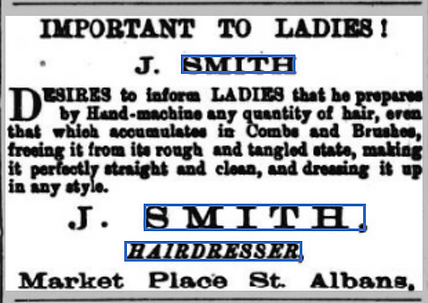
But business went downhill because by the time the
1891 census comes around, they had moved further
out of town to 19 High Street, Berkhamstead. He has given
the business to his son (26 Oct 1873 Herts Ad)
This was a very small terraced house and it was filled with children and ominously – no servant. They then moved to 19 High Street, Berkhanstead (the yellow one in the photo below). Imagine having 2 adults and 8 children in there. It has a fairly big garden though. I wonder where Joseph was conducting his business? Sometime after 1901, disaster struck the family. Joseph died about 1899. I don't know why he died, or when he died but this large family was left without the main bread winner and they had to leave the town that they had spent their whole lives in.


Left: High Street, Berkhamstead and no 19 is the yellow one. Imagine having 2 adults and 8 children in there. It has a fairly big garden though. I wonder where Joseph was conducting his business.
By 1901 Selena and her children were living at 7 Princes Terrace, West Ham. Princes Terrace has been completely rebuilt and is unrecognizable. But Selena had taken the bull by the horns and we see that at age 50 she was working as a hairdresser and tobacconist shopkeeper. And she was working for herself, as she was listed as an employer and the business was run from the home.
You have to admire Selena. She brought 12 children into the world and ran a successful business after Joe died. She was a tough lady.
Joseph and Selena had a big family.
Children
-
Mary Ann Smith b 1875 became a domestic servant
-
Maud Smith b 1877
-
Mabel R Smith b 1878 married 1st quarter 1878 St Albans
-
Rhoda Smith b 1881 d 1957. She married ? Plumbley. In both the 1901 and 1911 census she was living at home and her husband wasn’t there. Their children:
-
Doris Rhoda Plumbley 1908-1945
-
Hilda Ida Plumbley 1909 - 1974
-
Arthur R Plumbley b 1911 Forest Gate; d May 1989 Canterbury, Kent. He married Violet G Loynes in 1936 at St Olave Bermondsey.
-
Rhoda died 27 Feb 1957 at King George Hospital, Ilford, although she lived at 203 Henley Road, Ilford. Estate valued at £1650-10s-7d.
-
George Smith, b 1857 married draper’s assistant
-
Joseph Smith b 1882 and working as a hairdresser. He married Minnie from St Albans and settled at 34 Tylney Road, West Ham
-
William Smith b 1882 and working as a hairdresser
-
Florence Smith b 1885 not working but probably looking after the children
-
Henry (was Harry) Smith b 10 Feb 1886 working as a telegraph messenger. Could this be our Harry who then trained as a hairdresser? He turns up in the 1939 register working as a hairdresser and married to Sadie E. living at 32 Stanmore Road in Leyton, Essex.
-
Edith A Smith b 1888
By 1911 Selena was 60 and had retired and was living at 89 Clarement Road, Forest Gate.

Smith Research Option III - The German descendants
We have a Henry Smith aged 17, born and living in Islington and working as a hairdresser’s assistant, He was the son of Charles Smith (who also called himself Henry) and was born circa 1861 in Germany about (though he is listed as a British subject in 1901). Charles married Margaret and they lived at 8 Princes Street in 1899. The same address has 2 other families (a total of 16 people). And all 16 people had German names. Charles, Margaret and baby Adelaide would all have lived in one room. Princes Street has been renamed Raine street in Wapping.
The family would not recognize the area today as everything was demolished. It has been described as the oldest and most historically important in East London – was about to disappear. Its destruction, together with Swedenborg (originally Princes) Sq, a smaller neighbour to the east, erased two and a half centuries of history and ripped the heart out of this remarkable enclave of forgotten London. https://spitalfieldslife.com/2012/12/30/the-lost-squares-of-stepney/


We find that Charles and Margaret were living out at Dunstable when the 1901 census was taken, but by 1911 were back in London at 13 Holland Road Hornsey.
Victor John Smith/Edmonds/Edmunds
Victor was born and registered as Victor John Smith. He was born 11 May 1918 at Twyford Lodge, Willesden. In 1918 Twyford Lodge was Willesden workhouse. In 1914, the workhouse was renamed Willesden Institution, and then in 1921 became Park Royal Hospital. However, to protect those born in the institution from stigma in later life, their place of birth was recorded as "Twyford Lodge".

The Smith family continues to throw up strange things. Victor’s birth certificate was Smith, but he was known as Edmonds. When he changed his name back I am not sure, neither is his family. It was certainly early on, as his girlfriend and wife knew him as Edmonds in the 1940s.
Victor is a war hero! After leaving the orphange he joined the 1st Battalion Dorset Regiment in 1932. This was based at Portland Bill. From there he moved to Dover and in 1936 took part in the “Palestine Affair” (Ed: Israel’s heroic fight for independence). From there he returned to Dover and on to India on the North West Frontier. Following this he was posted to Malta for 3 years - living through the Siege (during WW2). The Allies lost thousands of men attempting to defend the strategically important island in the Mediterranean. It was here that he married Bibiana (Bibby) on 11 Aug 1942. Malta was an awful place to live in WW2 - for the younger readers see the Siege of Malta (https://warfarehistorynetwork.com/article/the-seige-of-malta-holding-on-to-the-island-fortress/)
The letter below was sent by Vic to Bibby, who had been evacuated to England. It was typical of the time in that it was not allowed to contain personal information or location of the sender.


Following the lifting of the siege, Vic took part in training in Egypt for the landings in Sicily and Italy and then returned to England to train for the landing in Normandy.
Bibi was born Bibiana Porsella on 17 Feb 1925. She was the daughter of Joseph Attard and Carmen Crecuola. Bibi had a brother Lawrence b 1930 and he moved to Australia. There was a set of twins Lawrence and Salvino but they died at birth in 1928.
Bibi and Victor Smith had four children:
-
Patricia Brenda Edmonds b 1946 married Peter Oakeby and have two children Tracey and Cheryl
-
Leslie Edmonds b 1948 married Sue Adnitt. They also have two children – Steven and Laura
-
Michael Edmonds b 1949 married Pauline Turner and they have three children – Clinton, Karla and Ricky
-
Robert Edmonds b 1954 married Sue Dean; secondly Lena and there is one child – Ryan.
I don’t have any decent photographs of this family apart from these:


My thanks to Vicki in NZ for sending some of the pictures. The lower 2 are of Vic in Australia. He did not keep in contact with the family.
Cyril Leslie Smith/Edmonds/Edmunds/Smith 1919 - 2005
Cyril was born 15 October 1919. Most of the information here I got from Cyril before he died. Cyril and his brother Vince were sent to St Mary’s Orphanage School when their mother remarried to Joseph Turner. Cyril was admitted with a last name Edmonds.
Cyril said that he was good at boxing and was a member of the school band. He had a picture of the band marching in a street that he said was Willesden in the 1930s.
At the age of 15 years and 5 months, Cyril was given an ultimatum - join the Army or go to Borstal. He chose the Army and his enlistment paper states that he signed up for 12 years (nine years with the Colours and 3 years with the Army Reserve). The form states that he was 5 foot 2½ inches tall and weighed 120 pounds. His girth, when fully expanded was 34½” and the range of expansion was 2”. His religion was Roman Catholic. His complexion was fresh, eyes blue and he had fair hair. He had a distinguishing mark of a mole over his right chest. He started his training at Tidworth near Salisbury. His army number was 318901.
After basic training Cyril told me that he joined the cavalry – 14th/20th Hussars as a boy on 15 March 1935. But on the very next day he joined the 9th Lancers. I will need to get some help understanding this because the record gives us this data:
Enlisted st Kingston upon Thames 15 Mar 1935 as a boy entrant in the 14/20th Hussars. The very next day he "parted and joined" to the 9th Lancers. He embarked at Southampton 18 Mar and was then cross-posted back to the 4/20th Hussars.On the 27 Nov 1935 he was cross-posted back to the 14/20th Hussars. He was promoted to the rank of trooper 15 Oct 1937. And on 11 Apr he transferred to the Royal Armoured Corps.


These are Cyril’s words……."In the 9th Lancers I played in the regimental band. I played bugle, trumpet, cornet and horn. I specialised in first aid and became a medic. I was the transferred to the 15/19th Hussars and posted to the Khyber Pass - North West Frontier where I loaded bullets into magazines and played in the regimental band at parties. The cavalry still had horses."
"I then transferred to 14/20th Lancers and saw service in India, specifically Trimalgaree, Pashaw, Delhi and Poona. By this time England was at war with Germany and I was based in Cairo and Alexandria. I then joined the 8th Army at El Alamein where I transferred from horses to tanks. The cavalry decided that mechanised transportation was better than horses and I soon found myself riding on armoured cars with 2 inch mortars. I then moved on to w wheeled armoured personnel carriers. It was during this time that I was wounded. A nearby Sherman tank was hot by an artillery shell and exploded, sending an inspection plate lancing into my body, causing me to be hospitalised. On my release I joined the 16th Lancers, seeing further service in the Middle East, chasing Rommel's troops back across the desert. At one time, our regiment was so close to Rommel that we could have killed hm, but the brass said that we should let him be as it is better to deal with the devil you know!"
"Eventually we returned to Alexandria in Egypt and I played in a concert. Towards the end of the war, my regiment was ordered back to England, taking the long way around via the Suez Canal and South Africa to avoid the U-boats of the Mediterranean, but we were tin-fished (torpedoed) on the way to Cape Town. I was lucky to have been picked up and was landed in India, eventually making it back to England in 1946. I went to stay with my mother, Alice Edmunds who was living at 21 Widegate Street, Bishopsgate."
After demobilisation, Cyril went to a training school in Watford to learn glassblowing. Then he worked in a factory making neon signs before moving onto St Albans working for for Marconi’s making HB electrodes. Then he moved to the De Havillands factory and was involved with moulding perspex canopies, windows and tail lights for aircraft . After a disagreement with his boss's son he resigned. At the Labour Exchange he was offered a job with the Green Line bus company and he was a conductor for three years before becoming a bus driver. He drove the long-distance routes. In the end he worked for the bus company for 35 years, all the while hoping he could get back to glass-blowing.
In St Albans, he took lodging with Mrs Florence Ada Sexton and met and married her daughter Florence Lilian Sexton. Photos above donated by Lilian Smith. They were married 27 Jan 1951 and lived in a council house at 32 Whitehedge Drive, Everlasting Lane in St Albans and, with the birth of their 4th child, moved to a bigger house at 46 Ladies Grove (400 yards away). Cyril was a keen fisherman and belonged to an anglers club and won many prizes in this sport. His interests also included snooker and darts and watch repairs. Cyril retired from the bus company sometime in the 1990s and took an active role at a sports club for retired people.


Florence Lilian Sexton.
Lilian and Cyril were married 27 Jan 1951 and lived in a council house at 32 Whitehedge Drive St Albans and also at 46 Ladies Grove (400 yards away). Cyril retired from the bus company sometime in the 1990s.
Cyril died 14 Oct 1919 aged 86 and his funeral cortege was pulled by 4 black horses. He was buried in St Albans cemetery. Lilian died 13 June 2002 and was buried at London Colney Road cemetary.
Cyril and Lilian had four children. In the interests of them still living and not being able to talk to two of them, only a brief overview is included:
Christine Smith. b 15 May 1952 Waverley Road Hospital St Albans Christine has been married twice. First to Christopher Wylde b 13 Feb 1949 (sales rep) and had a son Matthew Wylde b 1975; second to Ralph Smith b 16 Feb 1950 (mechanic) and had
Samantha Lillian Smith, b 22 Jan 1983 Northampton. Married Jon Facci b 31 Mar 1981. Children:
Isabella Florence Facci b 22 Aug 2018 Burton Latimer
Luca John Facci b 30 Sep 2022
Peter Smith b 20 Feb 1981 Northampton. Partner Myra Umali b 17 Apr 1973
Pamela Lesley Smith. b 17 Nov 1954 32 Whitehedge Drive St Albans. From the age of 4 Pamela wanted to become a teacher. She attended Sandfield School for Girls in St Albans and went on to study at St Osyth’s College of Education in Clacton-on-Sea between 1973 -76. At college she met Christopher John Alfred Dixon. They were married at St Michael's church, Verulamian 20 Aug 1977. Chris and Pamela emigrated to Australia in 1983 and lived in the NT until 2024. She and Chris are currebtly living in a Hiace van and doing the Big Lap of Ausyralia.
They have two children:
Rachel Pamela Shoshana Dixon. b 23 Aug 1977, a FIFO (fly-in-fly-out miner) in Western Australia.
James Trevor Alfred Dixon, b 23 Aug 1977 WHS safety officer at the Big Pineapple Tree tops challenge. James married Chloe Hopkins and they have three daughters:
-
Clare-Belle Elizabeth Dixon 18 Nov 2020 Darwin
-
Charlotte Ann Violet Dixon 9 Dec 2022 Darwin
-
Lucy Marian Amy Dixon 16 June 2025 Darwin
Angelina Heather Smith. Born in St Albans, Hertfordshire. Angelina trained as a nurse. Angelina came out to visit us and fell in love with Australia and subsequently emmigrated. She worked at a hospital in Perth and did some modelling on the side.
She met and married Brendan Riley. They have two children
Luke Riley
Rebecca Riley.
Sadly we have had no contact with the family for many years.
Trevor Edmund Lionel Smith. Trained as a hairdresser, like the disconnected Harry, then retrained in mental health. Trevor is a cognitive behaviouralist therapist specializing in adult mental health care, anxiety/panic, depression and older adult mental health care. He was the Critical Incident Staff Support Facilitator for South London and Maudsley NHS Trust. He married Susan Charlotte York and they have two children – can’t remember their names. Trevor has built up a good name in helping other people overcome all sorts of problems. He made it very clear to us on our last visit, standing on his doorstep that he no longer wanted any contact with his older sisters and their families. Recording of the interaction is on file.
This chapter is entitled the Smith disconnection. The chapter starts with a man who cut himself off from his family, and this chapter concludes with the current generation cutting itself off from their own family members. The two younger siblings refuse to talk and/or visit their older siblings (or their families). I have tried to identify the root cause of this animosity but I have not been able to find out why.
It’s important because the next generation are growing up and they don’t know their own first cousins. That is so sad. Young Charlie of Charlie and the Chocolate Factory was wiser when he turned down a fantastic job running Willy Wonka’s factory. He turned the job down because he would have to disconnect from his family, He said “I wouldn't give up my family for anything. Not for all the chocolate in the world.” Charlie is, in my opinion, an honourable young man.
St Mary's orphanage, near Heathrow airport
St Mary's orphanage for boys was established in 1847 at Southall lane, North Hyde, Southall. The buildings were part of former barracks used during the Napoleonic Wars (1799-1815) [1]. The object of the home was to 'receive boys chargeable to the poor rates within the metropolitan district and other pauper boys by agreement, and train them for trades, etc." In other words it was of a number of such institutions set up to remove Catholic children from workhouses, where it was feared, they would be likely to lose their faith. Boys entering the orphanage were aged between 7 and 14 years, with a certificate of health required and an agreed annual payment according to each individual's circumstances. Inmates remained until the age of 16. By 1890 the number in residence was 625. The school site is shown below - left the (1805) right now (2022)


The orphanage came into the care of the Brothers of Our Lady of Mercy of Malines in Belgium. Further buildings were added in 1870. In 1906, the institution was taken over by the Sisters of the Sacred Hearts of Jesus and Mary. It was a very large establishment housing as many as 600 boys with extensive grounds comprising sports fields and orchards, fields of crops, and even a farm with their own livestock. On September 18th, 1914, St Mary's was certified as an Industrial School for Roman Catholic boys under the age of 10 at their date of admission. St Mary's gave up its Industrial School status in 1929. It continued to operate for some years as an institution for Catholic boys from what was now the Public Assistance system and was under the inspection of the Ministry of Health. In 1935, it had 300 places for boys aged 3 to 14 at their date of admission.
The school was run by nuns who did the teaching side but there were also men employed. They took only boys and not all were orphans. Some came from families who simply could not look after them. The children were all baptised into the RC Church and later confirmed, there being a resident priest. They received a rudimentary education and were taught shoemaking and other crafts. Many of them were sent to join the armed services. Later on, in the 20s and 30s they had a very good band apparently and quite a strong sports element – Cyril was in that band). The nuns were very strict and used the cane a lot. I think they were allowed family visits on occasion. The orphanage, or school as it was then known, closed in the late 1930s - about 1938 I think, but the buildings remained and were used as offices for some years until the early 1950s. Until then they had a memorial service every year which took place around the memorial which stood at the gates and old boys used to go back for that. I don't think there is any connection with Heathrow Airport although I believe that at one time it was being considered as an additional runway site and British Airways, I think, used the building as offices. There is now a golf course on the site, which is rather better! I don't know if this is the only way it happened but children would be put into the care of the Board of Guardians of the Poor Law Unions. This would normally be where they lived or, if they hadn't lived there long enough to qualify for residence, it would be the Union to which their father had residence. Many of the London Union records are at the London Metropolitan Archives and are online with Ancestry. I couldn't find Willesden, so it may have been too far out geographically and may come under another county. The Union would have arranged for the children to go to establishments such as St Mary's. In many cases, siblings were split up, especially where there were brothers and sisters and they lost touch or didn't even know they had siblings.
The following photos were provided by Frances Bevan


Above: This was the reading and billiard room.
The missing war memorial
Cyril and Victor would have known the orphanage’s war memorial very well. Mystery hangs over the whereabouts of a large war memorial, once the focus of a large open air Mass each Remembrance Sunday. Two old residents of St Mary's school, a Catholic orphanage in North Hyde, Middlesex, have launched an appeal this year to find the monument commemorating many of their fallen comrades. More than 14 feet high, with a life-size cross, and figures of a soldier and sailor above a stone inscribed with more than 80 names, the memorial stood for many years on the roadside at the front of St Mary's School, Southall Lane, Middlesex.
The school was run by Sisters of the Sacred Heart of Mary and Jesus and supported by the Crusade of Rescue (now the Catholic Children's Society). Although the regime was spartan, the school was quite progressive for its time, with a swimming pool, a farm with livestock and a choir and band who were sometimes recruited to play for special occasions at Westminster Cathedral and Spanish Place.
Remembering the grounds in front of the school, ex-pupil Walter Adams said: "They were beautiful. There was a statue of the Sacred Heart and the war memorial looked like something you would see in Rome. A real work of art. Two of the names had the Military Medal and one had the Legion of Honour."
"Some things in life are printed in your memory forever," said another St Mary's old boy, Arthur Gaubert, 80, who attended the school from 1924-1933. During the inter-war years, each Remembrance Day, 600 boys, staff and local parishioners would assemble on the lawn in front of the monument, for a memorial service. "The school band would play, the choir sang hymns and then there was the last post," said Arthur. "By that point the atmosphere was electric. Many of the nuns would be weeping." Casualties from St Mary's were high. Several young men died during the Boer War and during the First World War many more were killed or went missing in action. In November 1917, the Mother Superior, Reverend Mother Attracta wrote: "I wish it would all end because our losses have been grievous. We've already lost 48 boys." Many more boys from the school were to give up their lives during World War Two.
Arthur and Walter became lifelong friends. During the Second World War they ended up on the same beach at Dunkirk on 28 May 1940. "The boat I was on, the Queen of the Channel, was sunk during the evacuation," recalls Arthur. I can still see the Junkers circling round overhead shooting at us." Both Mr Gaubert and Mr Adams got married and started families after the war. Mr Gaubert moved to Essex and ended up as a school headmaster. Mr Adams became a bandleader working on cruiseliners. He now lives in Cambridgeshire. In the years just after World War Two, together with other St Mary's old boys, they would visit the school to reminisce and pay their respects at the monument.
However, in 1953, the building was demolished, and the memorial disappeared. Its whereabouts is a mystery. During the war, the building had been requisitioned by the Air Ministry. Afterwards, for a few years, BOAC had offices at the school, while the grounds were being considered as a site for the new Heathrow airport. When the building was pulled down, Mr Gaubert, Mr Adams and a number of other friends made extensive efforts to trace the memorial. Ex-pupil Patrick MacManus, grandfather of singer Elvis Costello, spent several years trying to find it. After leaving the school MacManus was a bandleader and worker on the SS Olympia, sister ship to the Titanic. But he never forgot his old school. His son, the bandleader Ros MacManus (who worked with Joe Loss) said: "My father kept in touch with everyone and he never gave up his search for the monument. It is as if it had vanished into thin air." Mr MacManus died in 1963, but his son Patrick would still love to know what happened to the memorial.

This year Mr Adams and Mr Gaubert decided to redouble their efforts to find the missing monument. "Those boys were already dealt a very bad hand ending in an orphanage," said Mr Adams. "They ended up losing their lives in the trenches of the First World War before they had a chance. Most of them were under 20. I feel it is the least we can do for them." This week the Roman Catholic Diocese of Westminster, Hounslow Council, the Sisters of the Sacred Heart of Jesus and Mary and the War Graves Commissions were all contacted. None had any record of the memorial, although they would like to know any information that is discovered. "We don't know who made it, who paid for it, or where it is now," said Mr Adams. But the information must be somewhere. It can't have just disappeared." The War Graves Commission has told ICN they would be very interested to learn any information about the monument as they are just beginning to compile a directory of war memorials and have funding available for restoration.
The photos below were uploaded to his FB page by Barry Raymond, his grandfather was the sports teacher at the school.

Poor little waifs and strays. Cyril and Vic would have looked like this about 1925


Cyril was a member of the school band
Back to
Introduction Smith of High Wycombe. Smith of St Albans. Smith ex Germany.
Related families