
Jeremy Dixon 1952 - 2026
My brother Jeremy, who I always called Jedge, spelt Jegs, was one of my best mates. He passed away on 19 Jan 2026 at Boyup Brook Hospital in Western Australia. This is my recollection of his life.
Jegs was born in Harlesden, Norfolk on 17 June 1952. His parents were Pilot Officer Alfred Patrick John Dixon (John) and Marian Edna Dixon (nee Evans).
Dad was stationed at Harlesden in 1952 as an equipment officer. He had served in the RAF since 1935 and and was an aircraft engineer during the war, serving in North Africa. After the war he was demobbed, but was offered a position as a commissioned officer, which he completed in 1949.
Jegs (pronounced Jedge) was christened at Harlesden church and the family who could get to this isolated hamlet gathered for the occasion. Sadly, in those days, people could not afford to have large photos processed, so these are all we have.

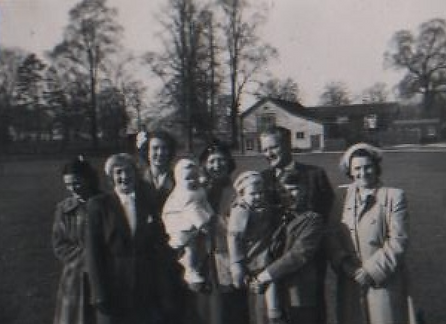
Jegs and Marian; Harlesden late 1952
Jegs and family; Harlesden late 1952
Sadly we don't know who most of the people are but Jegs is held by his grandmother Gertrude
By the time Jegs was a year old, dad had been posted to 86 Maintenance Unit, Hamburg. I have no idea what he was doing there, but our family lived at 2 locations (requisitioned houses) - one of which was in Conzestrasse, Blankanese, Hamburg, Germany. The family had a nanny, a German woman called]Vera.

Chris, Mum and Jegs in the garden Hamburg 1953

Jegs, Chris and dad in Hamburg Winter 1954

Chris, Jegs and our nanny Vera - Summer 1954

Jegs and Chros at RAF Padgate, Lancs - Summer 1956
I have taken some of the words our dad wrote for his page. "All too soon it was time for another move to No 53 M.U. at Pulharn (an explosive depot) where I took over the airfield storage at Bungay and we had a short sojourn in a bungalow opposite the station. The local publican had a terrace house in Harleston and I pursuaded him to offer it to the Air Force as a hired married quarter, which we subsequently occupied, and it was here that our second son Jeremy was born in June 1952 (another momentous occasion)."
In May the following year dad was posted to No. 86 Movements Unit in Hamburg and the tamily eventually followed and we lived in a lovely requisitioned house at Blankenese. Dad said, "This proved to be a most happy and enioyable tour and when the unit moved to Antwerp I remained in Hamburg to take charge of the detachment which was responsible for the movement of all RAF freight into and out of Hamburg docks. In June 1955 we rejoined the unit at Antwerp and settled in a penthouse on the Avenue de France for a very pleasant couple of years. By this time I was the Shipping Officer and among other duties I made regular trips to Zeebrugge to supervise the loading and unloading of explosive ships and trains"
Mum took Jegs and I on a train from Germany to Belgium. At this time, just 10 years after the end of the Second World War, there was not a lot of love lost between the Germans and British. Our mum made us promise we would not say anything. Ha! After just half an hour, Jegs piped up "Mummy I want to to to the toilet." This brought many irate stares from the other (German) passengers. However, we eventually arrived in Antwerp.
I went to an Army school and travelled there by bus, but Jegs was too young and he was enrolled in a school run by nuns. Mum had to walk him there and back again. He had to wear white gloves and he caused our mum no end of problems by insisting of running his gloved hands along the railings, ending up at school with filthy gloves. The nuns were not very loving and I expect this is where his hatred of religion started.
Jegs had an inquiring mind. I woke up one morning and found he had managed to smear black and brown boot polish on every surface of our bedroom. Mum was livid. Another morning found him trying to stick pencils into the 240 volt sockets in the wall. One memorable morning, Jeremy climbed onto the concrete parapet and shouted "look at me Mum!" There was no safety barrier and the penthouse was 7 floors above street level. I can also remember him throwing some of my toys over the parapet to the street below. Luckily they were soft toys.
After returning from two years in Belgium, dad was posted back to England to Wellesbourne Mountford as Plant Control Officer in charge of the storage and supply of airfield construction equipment and Marian. There was no accommodation for the family so dad found us a married quarter at RAF Padgate, Lancashire, a disused and abandoned RAF base that had been used during WW2. This wasn't ideal as it was a 2 hour drive away, so we didn't see much of dad. But we did attend the Padgate primary school.
I am sure that Jegs instigated the expedition to the old paint shed on the base and found a way inside. When we got home, absolutely plastered in a mixture of old lead paint, mum was even more livid and we both got soundly spanked and sent to bed. This was the only time we were punished in this way. Jegs and I attended the Padgate Church of England Primary School. But before too long, dad was given permission to move into a lovely married quarter at RAF Church Lawford. The trouble was, this was a Squadron Leader's house and dad was only a Flight Lieutenant. Mum spent a lot of money and time painting and decorating the house and it was a great place. But when a new base commander turned uo, he wanted the bigger house and we were turfed out and had to take the smaller house next door. Ahh the problems of rank.

Jegs at school, though I can't remember which one. I think it was Rugby Primary School in 1956 or 1957
Jegs and I loved this posting,. Church Lawford is a tiny village set in the Warwickshire countryside. There were only about 8 officers married quarters and the half dozen kids would all play together. We were let out early in the morning and our parents didn't see us till tea time. We explored the farm land and woods surrounding the base. There was so much to see... an abandoned rifle range and we found shell cases and live ammunition; a WW2 control tower and the blackboard showed the aircraft on the last bombing trip that had been carried out over Germany. I well remmeber crawling under the floorboards of numerous barrack blocks finding all sorts of interesting things. We built forts in the wood and watched the farmers harvest their crops in the traditional way.
We went to a primary school in Rugby and were picked up every morning by bus. One day, Jegs realised that he had forgotten his pencil case and he dived off the bus and ran across the road in front of the bus without looking, only to be hit by a car overtaking the stopped bus. I don't remember what happened at that point but the bus driver must have reported the situation. I do remember visiting Jegs in Rugby hospital and his head was bandaged up. The date was Nov 5 1957. I know this because the hospital rolled the patients out to see the traditional Guy Fawkes firework display. Jegs recovered.
On a sudden impulse our dad volunteered for a secondment to the Lebanese Air Force and much to his surprise was accepted and he flew out to Beirut in December 1958. He became the Equipment Advisor to the Lebanese Air Force which had recently been equipped with six Hawker Hunter fighter planes and a small RAF training mission. Mum, Jegs and I were left behind as was normal, but in December 1958 we made our way to London and flew out in one of thise new types of plane - a jet. All I remember was that there was massive turbulence and the plane dropped hundred of metres, making both Jegs and I vomit.
Lebanon was not a safe place to be, although for us it was probably safer than most. We lived in a couple of modern apartment buildings that and dad had a driver. We had maids. the buildings had security personnel. We had no idea of the political turmoil that Lebanon was going through, though we do remember a number of violent demonstrations and we could never forget the experience of battles taking place outside the flat, and tear-gas drifting up to us.
Mum and Dad took us to the beach and we learned to swim like fish. Dad had membership of the Bain Militaire (Beirut's Military Club), an exclusive club for officers set on the Mediterranean shore. When we weren't at school we spent every day there. Mum would sunbathe and we had free access to skiffs - flat bottomed boats made from wood and canvas - a forerunner to surf boards I suppose. We went out for hours, me aged 9 and Jegs aged 7, sometimes paddling all the way to Pigeon Rock. Ahh freedom. The last apartment we lived in was close to the beach... in this area I think. Hard to tell since so much has changed.

The Bain Militaire club was to the right of the picture, and our apartment
was close to where the tall green skyscraper is. There were no skyscrapers then. Our apartment, seven stories high was the tallest building, and there were vacant blocks everywhere. The European kids would have stone throwing fights with the arabs.
The concierge of this apartment had a dog, and one day it went crazy, and was killed and suspected of having rabies. Rabies is a disease of antiquity and has a history spanning millennia ever since the first interactions between humans and dogs. The authorities decided all the kids in the building had to be immunised. That meant one injection in the stomach over several days. This was early days for rabies treatment (the only virus that has a 100% death rate). The injections were huge and sometimes produced severe adverse reactions. The doctor bribed us ... if we didn't cry out, we would get a fruit pastille after each injection. I never cred, but Jegs screamed the house down. Needless to say we didn't go mad with rabies.

Jegs and I attended the Anglo American section of the Salesian Multi National school for Boys in Beirut. I recall small classes and the teachers were monks, and fairly strict. I well remember getting my fingers rapped for forgetting my pencil case. But there were fun times - I joined the Wolf Cub pack and had a dinky blue and yellow outfit. The toilets were disgusting holes in the ground. We were taken to school by armoured bus and had a guard with a rifle on every bus. One day, as we passed the central square, the bus driver told us we were not to look out of the left window. Of course we did and there a couple of bodies hanging. They had been lynched. We were told they were Israeli spies.
Our dad was doing an excellent job and was asked if he would extend his tour of duty there. However he felt that it was time I had a check up at Great Ormond Street Hospital in London. I haven't mentioned it before but I was born with double talipes (double club feet) and had to wear leg irons to my knees in the day time and leg irons up to my thighs at night. In the 1950s, treatment for double talipes (bilateral clubfoot) was transitioning from harsh surgical interventions to earlier, more conservative, yet often painful methods. I experienced the harsh methods.
Mum and dad never took pictures of me with my handmade boots with steel supports, but I was determined to live as naturally as I could and I was lucky to be taken on as a special patient of Dennis Browne, who was eventually knighted for his work in helping children to walk. He was Australian.


I was lucky to be taken on as a special patient of Dennis Browne, who was eventually knighted for his work in helping children to walk
So, after two and half years in Beirut, known as the Jewel of the Middle East, we returned home to England... but in a far more educational way than we had got there. Dad booked passage on a cruise ship that also carried cargo. Our Borgward Isabella car was loaded on board the SS Stelvio and we had a first class cabin. The Stelvio was a 4,408-ton passenger/cargo ship built for the Italian Adriatica Line. I can recall being treated right royally, particular;y when the ship went through a very rough 24 hours andall the passengers were sick, apart from me. I was the only passenger in the dining room, aged 10, being offered wine and waited on by the captain.
Once Jegs had found his sea legs we explored the ship (where we were allowed to go) and we both recall spending time on the bridge and the engine room. We watched the freight being unloaded and loaded in Latakia, Syria and in Izmir, Turkey. On that day Dad took us out in a pony-drawn taxi cab and we explored down town Izmir. The next stop was Crete and we were taken to explore the Palace of Knossos. Sadly Jegs and I only remember seeing old buildings. We didn't appreciate the most famous legend associated with Knossos is the story of the Minotaur, a creature with the body of a man and the head of a bull. King Minos of Crete kept the Minotaur in a labyrinth beneath Knossos Palace, which was so complex no one could escape it. The ship then steamed for 2 days across the Mediterranean, past Mt Etna in Sicily which did not disappoint - it was smoking. Mt Etna is one of the world's most active volcanoes and is in an almost constant state of activity. Mum and dad kept us busy playing long games of Jim Rummy. This also helped our counting skills.
We spent two days in Naples. Our parents organised a trip to Pompeii - and that was very memorable with the plaster casts of deceased people and the lurid murals in the brothel. Oh and who could forget the delicious gelato ice cream. Mum bought a camio brooch.
We then steamed past Sardinia and Corsica and dad told us about Napoleon, his life and battles. Eventually we arrived in Marseille and it was very cold. We watched the car being unloaded, piled ourselves and luggage in and set off north. It was a shock to see snow drifts piled high on the side of the road. Normally an 8 hour drive, it took us three days and we stayed each night in a hotel. Jegs and I played at loading our model vehicles into a ship (OK it was a vcarton of cigarettes) using shoe laces. Jegs had a Citroen van with sliding doors and I had a Citroen Light 15, which I still think is one of the sexiest cars ever!!.

A couple of days in Paris, we were taken to the Louvre and the Eiffel Tower before setting off north to XXX.
We caught the Silver City air ferry. to Ostend. The service doesn't exist today but we travelled on the top deck and the car travelled on the lower deck. An excellent film made the year after we were there can be found here.
After landing we set off for a bungalow owned by one of dad's friends in Beirut. It turned out to be a miserable, cold place not helped by the awful English winter.

Dad had some time off after serving as a technical advisor in the Middle East and while he was waitying for his net posting to come up, he decided that we should go back and live in Essex, a place where where dad had grown up. We moved into a rented farmhouse in Manningtree. Maningtree's claim to fame is that it is the smallest town in England. Jegs and I loved it - there were old barns and chicken coops and although it was still cold, there was a farmhouse kitchen with a coal fired cooking range. Jegs and I spent a lot of time playing with my building blocks. Never seen their like before, you used flour and water that glued them together - a sort of temporary cement. Together we designed and built bus stops, houses, garages and all sorts of interesting structures. We also learned to ride our bicycles. Jegs took to it really quickly but it took me a long time before I felt safe without training wheels, even though my bike was bigger. We attended a school in Manningtree, can't remember what is was called.
From Maningtree we moved to Clacton-on-sea to be closer to our grandmother (dad's mum). She was Gertrude Dixon nee Elkington. She and her husband (Alfred James Dixon) had run a restaurant/ice cream parlour in Clacton for many years. We took lodgings on the top floor of Anglesea House and Jegs and I started at Holland Road School. It was a long cold walk to school every morning and we both hated it - the walk and the school. Jegs said he learned some useful things such as how to dance like a willow tree, and set fire to dry leaves with a magnifying glass. I don't think we made much of an impression.
During this time, dad had been studying for promotion exams and was promoted to Squadron Leader and posted to RAF Bomber Command near High Wycombe. Squadron Leader dad's new job was keeping him very busy. He told me "my new job made me responsible for the chasing of spares urgently needed to keep our V bomber aircraft serviceable and the nuclear deterrent policy workable. It was a demanding job with little spare time away from telephones except for the occasional progress meetings at the various aircraft factories making the spares for the Victor, Valiant and Vulcan bombers." Indeed a very important job.
Jegs and I also loved this posting because the RAF base was surrounded by extensive forests and we could explore all day long. We attended Great Kingshill Primary School. Jegs and I remember the class teacher would call us up to her desk and make us read Dick and Dora reading books. Even though we had attended a number of schools, oir reading skills were very good, and we rarely got our legs slapped unlike so many of the other children. We learned out times tables to 12 off by heart. Neither of us were veruy good at history, geography or maths. In Lebanon we had learned about American geography (the Great Lakes and coalfields) and history and in maths we understood dollars and cents. Suddenly we were expected to be able to count in pounds, shillings and pence and have a good understandng of British history and geography. In these subjects we did receive some leg slaps.
I remember being a good lad, but Jegs was improving his naughty streak, and because he was my brother I often got caught up in his little schemes. He thought it would be a good idea to throw coke from the boys toilet area into the girls area. We had to stand outside the headmasters office all lunch time.
But dad wasn't impressed with our educational achievements and decided that boarding school would help us to gain an educcation we would badly need. Mum hated the idea od going to boarding school, and in hindsight she was right. We both hated boarding school and it would have been better if we had not gone. But dad had boarded at Colchester High School in Essex and his father had been a boarder at Ongar Grammar School. So in 1963 we were sent to Endsleigh school in Colchester. It was only just around the corner from dad;s sister, Phyllis Burns.

Jegs and I in Endsleigh School uniform. This photo was taken in 1961 at Clacton beach - you can see Clacton pier behind us. Jeremy was 9 and I was 11. As you can see the little squirt was as tall as I was.
We were based at the Lindens, a boarding house one mile from the school and we had to walk to and from school every day, in shorts, no matter how cold it was.
I loved this school, even though I started in Upper 3A, progressed to Lower 4B, then Upper 4C and when I left was in Lower 5D. Then again I had spent a lot of time in hospital having surgery on my club feet. Jegs, on the hand, steamed through school with very good grades.
Life at the boarding part of the school was pretty awful. The prefects were all Persian and tjey were veru cruel. Perhaps this is where my hatred of arabs started. On at least 3 evenings a week , when the youngsters were all in bed (bedtime was 730pm), they would throw open the dormitory door, storm in, tell us we had been talking after lights out and order all the boys out of bed to bend over the end of their beds and using their leather soled slippers would slap each boy's bottom 12 times. Prefects also handed out lines.
Notwithstanding the Persian bullies, Jeremy and I enjoyed school activities - Jegs wasn't a keen sportsman but he could run well and was picked for sports teams, unlike me who was unable to play sport at all. Jegs was good at most school subjects. Note - find his school results.
Sadly, for everyine, Endsleigh School closed down in 1975 and we were sent to another boarding school. We both loathed this school, run by ex British Army officers all of whom had survived WW2.
This story to be continued. Jeremy died in 2026.