
Alfred Patrick John Dixon 1919 - 2000
This section of the story has been written by "Paddy" himself, with some minor editing by me, Chris Dixon, his son. He was called Paddy by his family, John by the RAF.
"I was born 25th May 1919 at Dronfleld Road, Coventry, Warwickshire. My father was Alfred James Dixon, publican, ordnance engineer, racing driver, mason, restaurantier.
mM mother was Gertrude Annie (nee Elkington)."
"The family moved from Coventry to Enfield Wash in Middlesex, soon after I was born and mum and dad ran a popular pub called the "White House". I remember how spacious it all seemed at the time and how exciting the out-buildings were and admirably suited to the very young. I attended the local primary school for a couple of years before being sent as a boarder the the High School for Boys, Wellesley Road, Colchester, where I was to remain for seven years during which time I achieved one or two modest successes, regrettably few of them having any scholastic merit. These included Head Boarder, Head Boy, Scout Troop Leader, Captain of Cricket and Footbal, winner of three successive English prizes and the Dixon Cup for swimming."

School sports Paddy aged 11 at Spring Lane sports field, Colchester. Nora at left and Phyl on the ground. "Old Mr. Walker" is in the background. Donated Gertrude Dixon
Ed. This cup was one of Alfred James Dixon's cups that he won for motor-racing. AJ had the inscription on the cup filled in, re-inscribed and presented it to the High School as a cup for swimming.
"In 1929 the family moved to Clacton-on-Sea, Essex taking over a cafe and took over a confectionary business in Station Road. Dad joined the Chamber of Commerce and quickly rose to become president. He was also high up in the Freemason movement."
"Dad was a chain smoker and became very ill and Mum eventually had to give up the business to look after him and they moved to "Winster", in Elm Tree Avenue, Frinton-on-Sea. For two long years, Dad suffered with cancer of the bowel and despite major surgery at London Hospital died in 1935."
"Before he died it had been decided to enter me for an engineering apprenticeship in the Royal Air Force and ease Mum's task of caring for the family on her own. I duly sat and passed the entrance examination in 1935 and in August of that year entered the Halton Apprentices School near Wendover, Bucks for a three year course. As was customary at the time, children usually did what their parents thought best and I have little recollection of being consulted although my secret ambition was to have become a professional cricketer."
"I learned a lot at Halton and continued my love of sport. The photo below shows the Halton cricket team. I am in the front row second from right. Unfortunately I didn't work as hard as I could have done and had the ubiquiutous "can do better" on my report. "


Above: Dad (known as Paddy to his family) in his Halton uniform. Donated by John Dixon
Left: High School cricket team.
Below: Dad at Butlins Holiday camp
Donated by John Dixon


Above: RAF Halton cricket team. Dad is front row second from right. Donated by John Dixon


Left: "This picture dated 1937 shows No. I Wing, RAF Halton. I am second from right ~ front row (The two men flanking the central figure in uniform were quite famous in their day. After graduating from Halton they became ace fighter pilots during World War 2)."
"For my part in helping to win a football competition my fellow competitors were allowed an excursion to the famous Brooklands racing track."
"My dad had raced at Brooklands between WW1 and WW2 - see
"In those days before the War, Brooklands was and had been for quite a number of years, a very well known motor-racing circuit. On this particular occasion I was enthralled to see at close range the famous Napier racing car. The actual races of the day I remember not at all, except one particular race consisting of Austin Seven car. This was a race purely for lady drivers !! The photo (below) was taken by Basil Parfitt - no 568307."
An excellent Youtube film about about Halton can be found here - https://www.youtube.com/watch?v=5YUf4-FD3Xc
Dad told me "I managed to pass out in August 1938 as an Aircraftsman First Class and was entitled to service both engines and airframes and was posted to RAF Mildenhall in Suffolk to No. 149 Bomber Squadron.
"Nine months later it was off to the Middle East for a five year tour of duty, which was customary in those days, and after an uncomfortable journey vis His Majesty's Ship Dunera, arrived at Heliopolos, near Cairo to join 208 Army Co-op Squadron on 2nd May 1939."
Note the ship Dunera is infamous for transporting suspected spies to Australia in what Winston Churchill later regretted as "a deplorable and regrettable mistake"
"208 Army Co-op Squadron was a specialized Army Co-operation unit operating in the North African and Italian campaigns during World War II [1, 2]. When I was with them, the squadron was equipped with Lysanders."
"In September the squadron moved by road to Qasaba 10 miles east of Mersa Matruh in the Western Desert near the Libyan border and it was enroute I heard on the radio that war had been declared. For the next eighteen months I soldiered on. at a couple of desert encampments with the occasional Italian bomb falling but it was a halcyon period despite the shortage of water, the surfeit of bully beef and primitive living conditions. I found the desert to quite a memorable time. Even more memorable was when I succumbed to malaria in 1940, and after three attacks was evacuated to Alexandria hospital. Upon my recovery, I was posted to and RAF 102 MU (Maintenance Unit) at Abu Sueir, near Ismailia to work on the bench testing of aero engines. Abu Sueir was a crucial Royal Air Force station located in Egypt, about 72 miles northeast of Cairo and near the Suez Canal. During World War II, it served as a major training and operational airfield in the North African campaign."
"I found this to be the most absorbing job despite the noise and necessity for night work in the hot weather. A lot more noise was to be heard one night when the camp was raided by Stuka dive bombers causing sufficient damage to the depot for the test benches to be moved to Helwan (111MU), near Cairo."
Ed: Wikipedia tells us that "Maintenance units (such as 109 MU or 111 MU in the wider Egypt region) utilized test benches to run in aero engines (Allison, Pratt & Whitney, and Rolls-Royce Merlin) after overhauls to ensure they were ready for operational use."
"Our camp air-defence at the time had been near a Bofors gun and the following morning we were somewhat astonished to find an unexploded 250 lb bomb embedded 10 yards from our hut entrance, from which we had scampered to an adjacent air rais shelter the previous night."
"For the next two years my bench and I worked at Helwan and again at Helipolis until I was posted home in June 1943. The journey on a hospital ship round the Cape (of Good Hope, South Africa) took three months, one of which was spent in fairly, rioutous living in Cape Town."

The convoy taking Dad to the Western desert. Donated by John Dixon

Dad and mate outside their tent Fuica, Western Desert. Donated by John Dixon

Above: Working on the Lancaster engine. Donated by John Dixon

Dad and an unknown mate on leave. Donated by John Dixon

This a photo showing Dad's squad I think. He is in the back row, second from right. Don't know who Old Bill was.Donated by John Dixon

Above: Dad's aircraft testing engine setup. Right Dad circa 1944
Donated by John Dixon

"On my return to the UK in May 1946 1 had the good fortune to join the Handling Squadron at RAF Hullavington in Wiltshire who were developing servicing routines for the first Vampire aircraft, which gave me an insight into the mysteries of jet propulsion. From there it was to RAF Feltwell in Norfolk and then to RAF Wellesbourne Mountford in Warwickshire where I met my future brother-in-law Stanley Evans with whom I became great friends. In January 1948 we were both posted to RAF Finningley in Yorkshire and it was inevitable that I was introduced to his sister Marian Evans and in April of the following year were married at Sheffield. After a short honeymoon in London we took up residence in the first of our many homes at Vine Cottage, Dedham in Essex."
"Having completed my twelve year service engagement I was demobilised in June and headed for a career in civilian life. In order to pay the rent I took a job at Dedham flour mill (the one John Constable painted) as a general hand which consisted mainly of humping sacks of flour. I suggested an improvement to their automatic feed machine and was subsequently invited to become their engineer in charge of the machinery, a job which had a cottage nearby.
I often wonder what would have been our future if I had taken that job but by this time I had joined Ratcliffe's Garage in Colchester as a motor fitter. Soon after I was promoted to salesman and drove around the area selling spares and non-existent Vauxhall motor cars."
"In August 1949 1 heard from the Air Ministry that my previous application for commissioning had been approved and was invited to attend the Officers Training Unit at Spitalgate in Lincolnshire. Marian and I debated long and hard on what to do and where our best future would lie bearing in mind that Chris was due in November and Vine Cottage would be a most unsuitable residence. On a personal note it had always been my ambition to be commissioned - I had been previously recommended in Egypt - and felt that I had to accept the challenge it offered."
"Happily, Marian agreed and Mum, who had been to Canada for a few years, generously offered to accommodate Marian at Sea View, Layer Breton while I was away."
"And so in September it was off to OCTU for a demanding three months training in Air Force law, Kings Regulations, military history, fieldcraft and a number of stringent tests in handling command problems, none of which were made easier by being so isolated and far away from Marian."


Marian Evans 1948
John and Marian Dixon 9 Apr 1949 Sheffield, Yorks

OCTU 1949 Apologies for the poor standard of this photo. The original is in storage

Left: Officer Cadet Training Unit (OCTU) Paddy at the back of the assault course 1949.
"However, I was allowed a long weekend pass in November and scooted off to Feering nursing home to see Marian and Christopher - a momentous occasion."
"Chris was born with double talipes (double club feet)."
Ed: My parents never took pics of me in leg irons.
"Marian and I were reunited again during a weeks leave at Christmas and with Mum's help and advice we were able to plan and arrange for Chris's treatment for double talipes at Great Ormond Street Hospital."
"In late January 1950 1 passed out as a fully-fledged Pilot Officer watched proudly by Mum as I marched past the saluting base. And then it was yet another posting to RAF Bircham Newton to the Equipment Officers School for four months studying supply procedures."
"I managed to rent a third floor flat in a terrace on the front at Hunstanton and at last managed to adopt a more normal mode of family life for a brief period before being posted to RAF Compton Bassett in Wiltshire as Transport Officer."
"Mum, once again, cared for Marian and Chris while I scoured the area for accommodation eventually finding a top floor flat in Bromham Rectory miles from anywhere."

Christopher Dixon b 4 Nov 1949
Donated by Marian Dixon
"As luck would have it, well, not for the rector, he died about a month after we had moved in, and it was out on the street again and in desperation Marian and Chris were forced to move into the Kings Arms Hotel in Melksham. I couldn't afford to stay there as well, except at weekends and it took me some months before I located a pleasant ground floor flat facing the Green in Calne and we could be reunited."
"All too soon it was time for another move to No 53 M.U. at RAF Pulharn (an explosive depot) where I took over the airfield storage at Bungay and we had a short sojourn in a bungalow opposite the station. The local publican had a terrace house in Harleston and I persuaded him to offer it to the Air Force as a hired married quarter which we subsequently occupied and it was here that our second son Jeremy was born in June 1952 (another momentous occasion)."

Marian and Jeremy; Harleston. Norfolk. Donated by Marian Dixon

Christening of Jeremy Dixon, Harleston 1952
Jeremy is being held by John's mum Gertrude; I don't know who I am being held by - Rene's son or Stan's? Donated by Marian Dixon
"In May the following year (1953) I was posted to No. 86 Movements Unit in Hamburg and the family eventually followed me and lived in a lovely requisitioned house at Blankenese. This proved to be a most happy and enjoyable tour and when the unit moved to Antwerp I remained in Hamburg to take charge of the detachment which was responsible for the movement of all RAF freight into and out of Hamburg docks."

Chris, Jeremy and our nanny, Vera, 1954 Blankanese. Donated by Marian Dixon

Jeremy, Chris and Paddy Christmas 1954 Blankanese. Donated by Marian Dixon
"I well remember arranging a trip on one of the tramp steamers to take Chris to Hospital and was more than glad after the roughest of passages to disembark at Antwerp on the return journey and catch a train to Hamburg. We also managed a trip by Sabena airline which was a lot more pleasant way of travelling."
"In June 1955 we rejoined the unit (86 MU) at Antwerp and settled in a penthouse on the Avenue de France for a very pleasant couple of years. By this time I was the Shipping Officer and among other duties I made regular trips to Zeebrugge to supervise the loading and unloading of explosive ships and trains."
"Two years later we were off again, to RAF Wellsbourne Mountford as Plant Control Officer in charge of the storage and supply of airfield construction equipment and Marian and the children moved to a married quarter at Padgate, Lancashire until a married quarter became available at Church Lawford near Rugby where we spent a pleasant eighteen months. The children went to Rugby Primary School."
"On a sudden impulse I volunteered for a secondment to the Lebanese Air Force and much to my surprise was accepted and flew out to Beirut in December 1958 and became Equipment Advisor to the Lebanese Air Force who had recently been equipped with six Hawker Hunter fighter planes and a small RAF training mission. A most interesting post working at the Lebanese Ministry of Defence and at Beirut airport. The family duly arrived somewhat later and we lived in three different flats in a most enjoyable two year tour of duty. Although I was asked to extend my tour we felt that it was time Chris had a check up at Great Ormond Street Hospital and we returned home by cruise ship from Beirut to Marseilles and then by road to Southampton via Paris and Ostend to a bungalow offered to us by our neighbours in Beirut which proved to be most disappointing."
Ed: Dad was recognised by Fouad Abdallah Chehab, President of Lebanon as a valued officer who helped establish the Lebanese air force and he was awarded the National Order of the Cedar medal, by the president.

Paddy's medals L-R: 1939-45 Star; Africa Star; Defence Medal; 1939-45 War Medal; something else ; National Order of the Cedar
"From Portsmouth we moved to another dismal flat in Manningtree, Essex and yet another in Angelfield House at Clacton while waiting for my next posting, which was to be at Headquarters Bomber Command at High Wycombe, Buckinghamshire."
"By this time I had sat and passed the various promotion exams and was pleased to be granted the rank of Squadron Leader. My new job made me responsible for the chasing of spares urgently needed to keep our V bomber aircraft serviceable and the nuclear deterrent policy workable. It was a demanding job with little spare time away from telephones except for the occasional progress meetings at the various aircraft factories making the spares for the Victor, Valiant and Vulcan bombers. We had taken a furnished house for a year called Templar Mead and our biggest concern had become the education of the children which had suffered with all the various moves and they were clearly destined to undergo several more changes of secondary schools."

"After a lot of agonising we decided to send them to Endsleigh boarding school in Colchester which had a good local reputation and was near to Mum in Clacton and sister Phyl in Lexden. It was a great loss in 1962 when Mum died, a loss I still feel today some 27 years later."
"We also had the trauma and worry over Chris's operation at Carshalton Hospital in Surrey which happily proved successful."
"Sad to say Endsleigh School closed its doors and after visiting a lot of schools recommended by the educational gurus we decided to transfer the children to Pierrepont School in Surrey."
Ed: Both Jeremy and I loathed this school. Traditional private school, run by ex Army officers who had survived WW2. Bullying was endemic. And it was very expensive. The uniform could only be bought from Harrods. Jeremy joined the army cadets.
Jeremy & Chris Endsleigh uniform, Clacton 1961. Donated by Marian Dixon
"In September 1963 1 was posted to No. 92 M.U. which was a top-secret maintenance unit where I was Chief Equipment Officer responsible for the storage and transportation of nuclear weaponry. For this tour we lived in a married quarter on the camp at Faldingworth and it was at the Market Rasen golf course that I started my obsession with the game of golf. The job itself was quite unique but a bit scary living on top of, and dealing with such a heap of lethal ironmongery, and worrying all the time when one of my large convoys was on the road carrying nuclear capsules to London or the Lincolnshire airfields."
"We were not too displeased therefore, to be posted to Headquarters Fighter Command in March 1966 and take up residence in another married quarter in Stanmore, Middlesex, although my job was rather tedious being concerned with the supply and support facilities of radar spares and equipment to our Fighter stations."
"From there in March 1966, we moved to Cyprus and a furnished flat in Limassol. I was a Staff Officer at Headquarters Near East Air Force at RAF Episcopi dealing with the provision and supply of explosives, fuels and clothing which proved to be a most interesting job including trips to Malta and Libya to inspect their installations. I also managed a trip to Kuwait as captain of the combined services golf team."
"After a few months in Limassol we moved to a married quarter in Kensington village at Episcopi. Chris had left school and took a job as clerical officer at the Headquarters while Jeremy commuted to school by air for a few months until leaving Pierrepont to join the RAF school at Episcopi for a while before also getting a job as a draughtsman. It was an idyllic tour in beautiful surroundings, superb weather and working hours were only from seven until two, giving us plenty of spare time to enjoy the island and the excellent service amenities plus plenty of golf (handicap down to 4) and even the odd trip to a UN conference in Turkey. It was with great sadness that we left Cyprus after three years, in May 1971 and returned to 108 Douglas Road in Clacton which had Mum had bequeathed to us believing that we would always need a "bolthole" in our nomadic life-style, and how right she was. It had always been a joke between us when I stayed there that I had to keep my "half' clean and tidy since I was paying most of the mortgage."
"From here it was to No 16 MU at Stafford as the Anglo-French Project Officer to liaise with the various supply agencies procuring helicopters - a dull job with a lot of boring and interminable meetings at the Ministry of Defence in Whitehall. Added to this we had a rotten married quarter, the children had gone their separate ways and neither Marian or I liked Stafford at all. It was here that we decided the time had come to seek pastures new and I applied for early retirement from the RAF at the age of 52 instead of the mandatory age of 55."

John Dixon
Sqn Ldr John Dixon left of the Officer Commanding 92 MU inspecting the troops. Donated by John Dixon
"In preparation, I obtained membership of the British Institute of Management and attended a management course at the London Polytechnic sponsored by the RAF and also took a correspondence course in golf club management. The latter subject appealed and at the third application I was accepted as the Secretary/ Manager at Ipswich Golf Club in Suffolk. I commuted there daily from Clacton for about seven months until we bought a bungalow at 117 Bucklesham Road, Ipswich which adjoined the golf course."
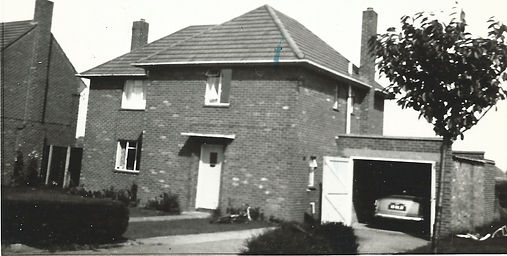
Married quarter RAF Bomber Command, Borgward in garage. Donated by Chris Dixon

RAF Episkopi Combined Services Golf Team 1970. Donated by John Dixon
"I enjoyed the job immensely for a few years becoming quite immersed in the management aspect which almost completely overtook my interest in playing golf. It was a delight to have achieved stability in our lives and a sense of permanence, which led me to strip our packing cases and use them as a floor in the attic. Little did I know that the fates had yet another move in store."
"By this time the children had gone about their respective careers and in the case of Jeremy a wedding to Evelyn 'Lyn' Ratclife and to our dismay an emigration to Australia. Chris completed a three-year teacher training course and marriage to Pamela Smith."
"Marian and I took stock of the situation and since I had become somewhat disenchanted with the golf club we pondered on what we should do. Retiring in Ipswich for the rest of our lives did not appeal and we considered Spain, Portugal and Cyprus as possible anchorages. About this time in 1980 Jeremy had an unhappy divorce and we decided that a holiday in Australia might do us all good and it may turn out to be a suitable retirement home. This proved to be the case after a pleasant month in the sunshine of Perth in Western Australia."
"And so, about a year later, we flew out to our new home which was to be 20 Hillside Crescent, Gooseberry Hill in the foothills near Perth. Much to our delight Chris and Pamela were able to join us later.
Jeremy met and married Bonnie Barker and in 1988, 1989 and 1991 we became proud grandparents of Rachel, James, Patrick and Daniel (four momentous occasions).

Rachel & James Dixon 2016
Donated by James Dixon

Daniel Dixon. Donated by Jeremy Dixon

Patrick Dixon. Donated by Jeremy Dixon

Marian & Paddy. Gooseberry Hill WA. Donated by Chris Dixon

Dad's last posting. Donated by Chris Dixon
Dad enjoyed his last years in Gooseberry Hill. He played golf every day until his health deteriorated. He studied art and got a Diploma. He helped Jeremy with his photographic business accounts. He loved playing his organ
He died 4 Feb 2000 of emphysymia. He was cremated and mum said his last posting was when she sent his ashes to be interred in the family burial plot in Kirby Cross near Frinton, Essex.
List of Units and Places Paddy served
1935-38 RAF Halton, Bucks Apprentice training
1938-39 Mildenhall, Suffolk 149 B Sqn.
1939 Heliopolis, Egypt208 AC Sqn
Western Desert, Egypt ditto
1940 Abu Sulu, Egypt 102 MU Test Bench
1941 Helwan, Egypt 111 MU ditto
1942 Heliopolis, Egypt109 MU ditto
1943 T6mpsford, 138 Sqn
1944 Woolfax Lodge, Lincs 1651 CU
1945 Tuddenham, Suffolk 32 Base
1946 Upwood, Suffolk 2 LSU
1946 Bari, Italy LSU
1946 Pomigliano, Italy LSU
1946 Hullavington, Wilts 3 FrS
1947 Feltwell, Lincs 3 FSTS
1948 Wellesbourne 3 GTS
1949 Finningley, Yorks 3 SFrS
1949 Feltwell, Lincs 3 FrS
1949 Mistley Farm Mill, Suffolk -
1949 Ratcliffes Garage, Colchester
1949 Spitalgate, Yorks OCTU
1950 Bircham Newton, Norfolk Equipt Officer School
1950 Compton Bassett 15 Sqn TT
1951 Nth Coates, Lincs XF Course
1952 Pulham 53 MU (X)
1953 Hamburg, Germany 86 MU
1955 Antwerp, Belgium 86 MU
1957 Wellesbourne ACB
1958 Beirut, Lebanon LAF
1960 High Wycombe, Bucks HQBC
1963 Faldingworth, Lincs 92 MU
1966 Stanmore, Middx HQFC
1968 Episcopi, Cyprus HQNEAF
1971 Stafford, Staffs 16 MU
1972 Ipswich Golf Club
1982 Kalamunda, Australia

Abbreviations
AC
ACB
BC Bomber Command
CU
FC Fighter Command
FSTS
FTS
GTS
HQ Headquarters
LAF Lebanese Air Force
LSU
MU Maintenance Unit
NEAF Near East Air Force
OCTU Officer Cadet Traininj
Unit
SFTS
Sqn Squadron
x Explosives
Where our caravan has rested (or where we have called home since we married)
Sea View Cottage, Layer Breton, Essex
1949 Vine Cottage, Gun Hill, Dedham
1949 Sea View Cottage, Layer Breton, Essex
1950 Hunstanton, Norfolk
1950 The Rectory, Bromham, Wilts
1950 Kings Arms Hotel, Melksharn, Wilts
1950 The Green, Calne, Wilts
1951 Holten-le-Clay, Lincs
1951 The Bungalow, Harleston, Norfolk
1951 Wilderness Terrace, Harleston, Norfolk
1952 Blankanese, Hamburg, Germany
1952 Conzestrasse, Blankanese, Hamburg, Germany
1953 Penthouse Flat, Avenue de France, Antwerp, Belgium
1955 Married Quarters, Padgate, Lincs
1955 Married Quarters, Church Lawford, Warwicks
1956 Married Quarters, Church Lawford, Warwicks
1957 Bottom floor flat, Beirut, Lebanon
1957 Top floor flat, Beirut, Lebanon
1957 Pigeon Rock, Beirut, Lebanon
1958 The Bungalow, Southampton, Sussex
1958 Mistley, Suffolk
1958 Anglefield House, Clacton-on-Sea, Essex
1958 Templar Mead, Bucks
1959 Married Quarters, Burnham Beeches, Bucks
1960 Married Quarters, Faldingworth, Lincs
1963 108 Douglas Road, Clacton-on-Sea, Essex
1963 Married Quarters, Stamnore, Middx
1966 Limassol, Cyprus
1966 Married Quarter, Kensigton Village, Episcopi, Cyprus
1971 108 Douglas Road, Clacton-on-Sea, Essex
1973 Bucklesham Road, Ipswich, Suffolk
1982 20 Hillside Crescent, Gooseberry Hill, Kalamunda, Western Australia.
Self portrait by John Dixon